

Key points:
- Learn practical ways to teach requesting, responding, and conversation skills during everyday routines at home.
- Discover how small changes in structure and reinforcement increase motivation and reduce communication breakdowns.
- Build confidence using proven ABA-based tools that support steady progress in real family life.
Communication challenges at home can feel overwhelming. When a child struggles to express needs, understand directions, or join conversations, everyday moments may turn into frustration for everyone. Applied Behavior Analysis, or ABA, offers practical tools families can use to strengthen communication in natural settings. Research from university and government supported programs shows that structured behavioral strategies can significantly improve language, social interaction, and daily living skills when used consistently at home.
This article focuses on clear, family-friendly steps you can start today. You will learn how to support requesting, build stronger back-and-forth conversations, create predictable routines, and respond effectively to challenging moments. The goal is not perfection. It is steady progress, meaningful connection, and more peaceful communication within your home.
Why Communication Often Breaks Down at Home
Many children with developmental differences experience delays in expressive or receptive language. National public health data estimate that about one in thirty six children are identified with autism spectrum disorder, and communication differences are a core feature. Language delays may include difficulty asking for help, labeling feelings, answering questions, or following multi-step directions.
At home, communication challenges often appear as:
- Tantrums when a need is not understood
- Repeating phrases without meaningful interaction
- Avoiding eye contact or social engagement
- Difficulty transitioning between activities
These behaviors are often forms of communication. ABA helps families look at what a child is trying to express and then teach a clearer, more effective alternative.
Understanding this shift in perspective is powerful. Instead of focusing only on stopping behaviors, you focus on teaching better communication skills that replace them.
Building Strong Foundations Through Motivation
Effective communication begins with motivation. Children communicate more when they see a benefit. ABA emphasizes identifying what truly motivates your child, then using those interests to encourage interaction.
Start by observing what your child naturally enjoys. This could be snacks, toys, music, or physical play. Once you identify strong motivators, you can shape opportunities for communication around them.
For example:
- Hold a favorite toy briefly and wait for a request
- Pause a favorite song and encourage a gesture or word to continue
- Offer small portions of a preferred snack to create repeated requesting opportunities
These simple steps strengthen manding skills, which refer to a child’s ability to request what they want or need. Teaching requesting reduces frustration and gives your child a clear, effective way to communicate.
When you respond quickly and positively to appropriate requests, you reinforce communication. Over time, children learn that using words, gestures, or pictures works better than crying or grabbing.
Teaching Requesting and Early Language Skills
Developing requests is often the first communication goal in ABA programs. Research from university-based behavioral studies shows that strengthening functional requests can decrease challenging behavior and increase independence.
To support manding skills at home:
- Create small communication opportunities throughout the day
- Wait briefly before helping, allowing space for a request
- Prompt gently if needed, then fade support over time
- Immediately provide the requested item when communication occurs
If your child uses single words, model short phrases. If your child is nonverbal, accept gestures, picture exchanges, or device communication. The key is consistency.
Pair these efforts with practical expressive communication tips, such as:
- Speak in short, clear phrases
- Model the exact words you want your child to use
- Repeat and expand on your child’s attempts
- Celebrate every effort, not just perfect speech
Progress may start small. A single word request is meaningful growth. Consistent practice during daily routines leads to steady improvement.
Using Everyday Routines for Language Growth

One of the most effective ways to improve communication is to embed teaching into normal routines. Structured repetition builds familiarity and confidence.
Morning routines, mealtime, bath time, and bedtime all provide natural opportunities for language building routines. These predictable sequences help children anticipate what comes next, making it easier to practice communication.
During meals:
- Encourage requesting specific foods
- Practice labeling items on the plate
- Ask simple choice questions
During play:
- Take turns with a toy
- Model short phrases
- Pause to allow your child to comment or request
During bedtime:
- Review the day using simple language
- Label emotions
- Encourage your child to finish familiar phrases in books
Consistency is more important than complexity. Repeating the same communication patterns daily strengthens understanding and expressive skills.
Strengthening Back and Forth Conversation
Communication is more than requesting. It includes shared attention, turn taking, and responding to others. ABA uses structured practice to build these skills gradually.
Start with brief, simple exchanges. Roll a ball back and forth. Take turns stacking blocks. Pause and wait for your child to respond before continuing. These interactions teach the rhythm of conversation.
To expand skills:
- Ask predictable questions with clear answers
- Offer choices instead of open ended questions
- Model simple comments about what your child is doing
- Reinforce eye contact and listening behaviors
If your child struggles to answer questions, use visual support or provide a verbal model first. Gradually reduce assistance as independence grows.
These speech support strategies work best when they feel natural and playful rather than forced.
Reducing Frustration and Challenging Behavior
Challenging behavior often decreases when communication increases. Studies from federally funded behavioral research programs show that teaching alternative communication significantly reduces problem behaviors in many children.
When frustration appears:
- Pause and assess what your child may be trying to communicate
- Prompt a clear request or phrase
- Reinforce immediately once communication occurs
Avoid long verbal explanations during meltdowns. Instead, keep language short and calm. Once your child is regulated, revisit the communication goal in a structured way.
Consistency across caregivers is critical. When everyone responds similarly, children learn faster. Family meetings can help align expectations and strategies.
Using Visual Supports and Structured Prompts
Visual tools often enhance learning, especially for children who process information more easily through pictures than speech. Research from educational institutions shows visual support improves comprehension and independence.
Consider using:
- Picture schedules
- Choice boards
- Visual cue cards for common phrases
- Emotion charts
Visual supports strengthen language building routines by providing predictable structure. For example, a visual schedule for morning tasks reduces confusion and prompts communication about what comes next.
Prompting is another essential ABA tool. Prompts may include gestures, modeling, or gentle physical guidance. The goal is always to fade prompts gradually so your child communicates independently.
Encouraging Generalization Across Settings
A skill learned in one room may not automatically appear elsewhere. ABA emphasizes generalization, which means practicing communication in multiple environments.
If your child learns to request juice in the kitchen, practice requesting in the living room, backyard, and during outings. Vary the people involved so communication expands beyond one caregiver.
You can support generalization by:
- Practicing skills during errands
- Encouraging siblings to participate in communication games
- Using the same phrases consistently across settings
These consistent speech support strategies ensure communication skills transfer into real life situations.
Supporting Emotional Expression
Communication includes expressing feelings. Teaching emotional language reduces behavioral outbursts and strengthens self awareness.
Model simple emotion words daily. Label your own feelings in calm moments. Use books or pictures to discuss facial expressions.
Practical expressive communication tips for emotions include:
- Offering two feeling choices when your child appears upset
- Encouraging use of “I feel” statements
- Reinforcing calm verbal expression of frustration
Over time, children learn that words can replace physical reactions.
Tracking Progress and Staying Encouraged
Progress may feel slow at times. Tracking small improvements helps maintain motivation. Keep a simple notebook documenting new words, clearer requests, or smoother transitions.
Look for patterns. Notice which routines produce the best communication. Adjust your approach if progress stalls. Even incremental growth is meaningful.
Remember:
- Improvement is rarely linear
- Consistency matters more than intensity
- Short daily practice is more effective than occasional long sessions
Family support networks and parent training programs can provide additional guidance and reassurance.
Partnering With Professionals While Leading at Home
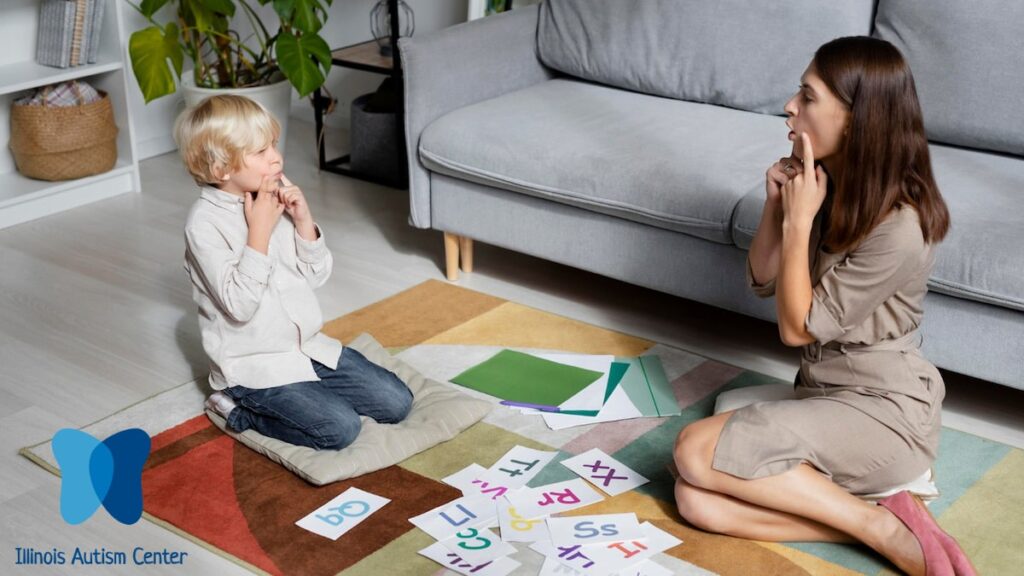
While professional guidance can be valuable, parents remain the most powerful teachers. Communication practice happens most often at home, not in therapy sessions.
When working with professionals, ask for:
- Clear, measurable communication goals
- Demonstrations of prompting techniques
- Guidance on fading support
- Home practice plans
You do not need technical language to be effective. What matters is understanding the purpose behind each strategy and applying it consistently.
Your daily interactions shape your child’s communication growth. With structured routines, thoughtful reinforcement, and patient modeling, meaningful change is possible.
FAQs
How long does it take to see communication progress with ABA strategies?
Many families notice small improvements within weeks, especially in requesting. Consistency at home greatly influences how quickly new communication skills develop.
What if my child does not speak at all?
Communication includes gestures, pictures, and devices. Strengthening manding skills using alternative methods still reduces frustration and builds meaningful interaction.
Can siblings help support communication growth?
Yes. Siblings can model turn taking, practice simple questions, and reinforce appropriate requests during play, helping generalize skills naturally.
How often should we practice communication routines?
Short, daily practice during natural activities works best. Embedding language building routines into meals, play, and bedtime increases consistency without overwhelming families.
Do ABA strategies work for older children?
Yes. Communication growth is possible at any age. Strategies can be adapted to developmental level, focusing on practical and age appropriate goals.
Turn Everyday Moments Into Meaningful Conversations
When communication improves at home, daily life becomes calmer and more connected. Structured ABA services in Illinois help families apply practical expressive communication tips that strengthen language in real time.
At Illinois Autism Center, clinicians design personalized programs that build manding skills and support functional language growth across settings. Caregivers learn how to use consistent prompts, reinforcement, and simple routines that encourage clearer requests and stronger engagement. Therapy extends beyond sessions, helping families feel confident guiding progress at home.If you are ready to replace frustration with understanding, reach out to us to explore how ABA therapy can support communication growth in ways that feel natural and sustainable.