
Key Takeaways
- Speech delays affect how a child learns to use words, while autism affects social connection and communication intent.
- Late talkers usually show strong eye contact and gestures, while autism often includes fewer social cues.
- Autism may involve repetitive behaviours and routine sensitivity, while speech delays do not.
- Early evaluation helps families understand the difference and get the right support quickly.
It is natural to worry when your child does not hit their communication milestones at the same time as other kids. You may have a late talking child. You may wonder if this is a simple communication delay or something more. These questions can feel heavy. It can also feel confusing. Yet you are not alone. Many parents stand in this same place. The good news is that clarity is possible.
This guide breaks down the difference between a speech delay and signs linked to Autism Spectrum Disorder (ASD). It uses current research, real-world examples, and simple explanations to help you move forward with confidence. Early answers matter. Early support matters. Most of all, understanding the difference helps you take the next step with peace of mind. Read on to learn the key differences.
The Story of Thomas: A Case of Autism Symptoms vs. Speech Delay
Picture Thomas at age two. His parents felt a small tug of worry. He used only a few words. Friends told them, “Einstein did not talk until he was five!” That gave some comfort. Yet the worry stayed.
Thomas was bright and curious. He understood everything they said. When they asked him to bring the red ball, he grabbed the right one every time. He loved hide-and-seek. He pointed to the toys he wanted. He made strong eye contact to check if they saw him. He tugged on a shirt for a hug. He laughed with his parents during silly play.
When they took him in for an evaluation, the specialist found an expressive language delay. His challenge sat in the production of speech. His social language development stayed on track. His gestures, his desire to connect, and his clear understanding of language showed a communication delay, not ASD.
Thomas helped his parents see an important truth. A speech delay affects “how” a child communicates. Autism touches deeper areas. It affects social connection, play, and the way a child interacts with the world.
This simple story shows why the distinctions matter.
What Are the Signs of Delayed Speech?
Speech delays are common. Research suggests they affect about 10% of preschool-age children (Shriberg et al., 2017). A delay happens when a child does not meet typical communication milestones for their age. Some delays affect speech only. Others affect language. These two areas sound similar, yet they are not the same.
Speech vs. Language: Know the Difference
Speech Disorders
These involve the mechanics of talking. This includes how sounds are formed, how speech flows, and how loud or soft the voice is.
Language Disorders
These involve meaning and the use of words. A child may struggle to understand language or use words to express thoughts clearly.
Articulation Disorder (Speech)
An articulation disorder happens when a child struggles to produce certain sounds. They may replace a sound, skip it, or distort it. For example, a child may say “wabbit” instead of “rabbit.” This is also known as a speech sound disorder, according to ASHA (American Speech-Language-Hearing Association).
Language Delay
Language delays fall into two types.
Receptive Language Delay
The child has trouble understanding words or following directions. A simple command like “put the block in the box” may feel confusing.
Expressive Language Delay
The child knows the words but struggles to use them. They may have a small vocabulary. They may not combine words to form short sentences.
Key Milestones to Watch
Children develop at different speeds. Yet the milestones below offer useful guidance.
| Age Range | Sign of Possible Delay |
| 4–6 months | No babbling |
| By 12 months | No consonant-vowel sounds like “da” or “ma” |
| By 18 months | Only a few words; uses gestures more than vocal sounds |
| By 24 months | Fewer than 50 words; not combining two words |
| Three years | Not using simple three- to four-word sentences |
| Four years | Cannot tell a simple story or form four- to five-word sentences |
Common causes include hearing loss (sometimes due to repeated ear infections), developmental differences, or genetic conditions such as Down syndrome. A speech delay may also be one early sign of ASD. This overlap is why parents often compare autism symptoms vs. speech delay.
What Are the Early Signs of Autism?
Autism Spectrum Disorder (ASD) is a neurodevelopmental condition. It affects communication, social interaction, and behavior. The CDC estimates that about 1 in 36 children in the U.S. are identified with ASD based on 2020 data. Early signs can show up during the first two years of life.
The key signs fall into two broad areas. These areas set ASD apart from a general communication delay.
1. Social Communication and Interaction
Children on the spectrum often have difficulty with social “give and take.” This may show up in several ways.
- Eye Contact: Reduced eye contact or avoidance.
- Nonverbal Cues: Trouble interpreting tone, facial expressions, or body language.
- Responding to Name: Little response when called by name, especially by 12 months.
- Joint Attention: Difficulty sharing focus on an object, such as following a point toward a toy.
- Social Preference: A stronger pull toward solitary play.
These signs relate to deeper differences in social development, not just words.
2. Restricted or Repetitive Behaviors
These behaviors vary from child to child. They may include:
- Repetitive Movements: Rocking, spinning, or hand-flapping.
- Echolalia: Repeating words or phrases without clear purpose.
- Routine Sensitivity: Strong distress with changes in routine.
- Focused Interests: Intense interest in one topic, activity, or part of an object.
These patterns may appear early and give clues to a broader developmental difference.
The Role of Genetics
Research points to genetic and environmental factors. Studies with twins suggest a strong genetic component (Sandin et al., 2017). Many genes may contribute. At this time, research does not support a link between ASD and vaccines.
Autism Symptoms vs. Speech Delay

The key difference lies in the type of communication challenge.
A speech delay affects how a child speaks. Autism affects why and how a child communicates socially.
Children with a simple speech delay:
- Show interest in social connection
- Seek hugs and attention
- Use gestures like pointing and waving
- Share interests
- Use eye contact to connect
Children on the spectrum may:
- Use fewer gestures to share interests
- Prefer more solitary play
- Show differences in eye contact
- Repeat phrases instead of using spontaneous speech
- Show repetitive behaviors or strict routines
These details help families see the difference in communication intent.
Comparison Snapshot
| Feature | Speech Delay (Late Talker) | Autism Spectrum Disorder (ASD) |
| Social Intent | Seeks close connection | May prefer more time alone |
| Eye Contact | Natural, social | Limited or inconsistent |
| Gestures | Points, waves, shares | Fewer gestures for sharing |
| Speech Pattern | Trouble forming sounds | May show echolalia or flat tone |
| Behavior | Typical toddler behavior | Repetitive behaviors, strong routines |
Parents often compare autism symptoms vs. speech delay because the overlap can be confusing. These differences help point the way.
When Should You Seek an Evaluation?
Early evaluation helps children with any communication delay. Research suggests early support can improve outcomes for children on the spectrum (Dawson et al., 2010). It can also help a child with a simple speech delay build skills faster.
Red Flags That Call for an Evaluation
- No babbling by 12 months
- No single words by 16 months
- No two-word phrases by 24 months
- No response to their name
- Any loss of speech or social skills
Regression is especially important. Loss of skills at any age calls for immediate evaluation.
During an assessment, the clinician may look at:
- Eye contact
- Gestures
- Language comprehension
- Play skills
- Sound production
- Social interaction
A full picture helps show whether the child has a communication delay, ASD, or both.
How Can Speech Therapy Help Language Development?
Speech therapy supports both conditions, though the goals may differ.
For Speech Delays
Speech-language pathologists (SLPs) help children:
- Practice sound production
- Build vocabulary
- Form short sentences
- Improve listening skills
- Follow simple directions
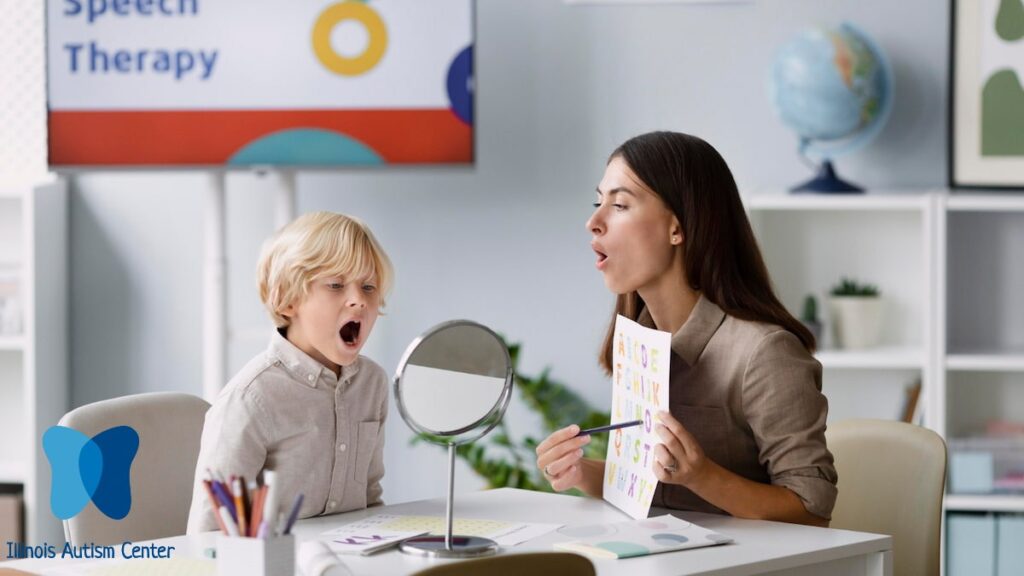
Sessions are playful. Children may practice sounds through games, songs, or picture cards.
For Autism Spectrum Differences
Therapy expands to include social communication skills.
SLPs may support:
- Taking turns during conversation
- Understanding facial expressions
- Staying on topic
- Using gestures or words to express needs
- Adjusting tone or volume
Children may also use visual supports or structured routines to build confidence.
The Power of Play
Many sessions happen through play. Play creates chances to build language skills during natural moments. Parents who practice at home see faster progress.
What Other Supports Help Children with Autism?
A child with ASD may benefit from a team-based approach. Options may include:
Behavioral Therapy
Often includes Applied Behavior Analysis (ABA). ABA focuses on new skills, positive behavior, and functional communication.
Occupational Therapy
Supports motor skills, daily routines, and sensory processing.
Social Skills Groups
These offer guided practice with peers. Children learn social cues, conversation skills, and cooperation.
Plans vary. Each child receives a personalized approach based on their needs.
Key Takeaway: Speech Delay vs Autism

A speech delay does not equal autism. Many children who are late talking or who show a communication delay do not meet the criteria for ASD. The main differences lie beyond speech.
Look at your child’s:
- Desire to connect
- Use of eye contact
- Use of gestures
- Play patterns
- Presence of repetitive behaviors
Understanding autism symptoms vs. speech delay gives you power. It helps you make informed decisions. It helps you get the right support at the right time.
Frequently Asked Questions
1. What if my child was babbling but then stopped?
Loss of skills is called regression. Any regression deserves immediate evaluation.
2. Can a child have a speech delay without autism?
Yes. A child can have articulation challenges or language delays without ASD. These often respond well to speech therapy.
3. I see both speech delays and social differences. What should I do?
Seek a comprehensive evaluation. A developmental pediatrician or a multidisciplinary team can provide clarity.
4. What is echolalia? Why is it linked more to ASD?
Echolalia means repeating words or phrases. It can occur in typical development. Persistent echolalia, especially without clear communication purpose, is more common in ASD.
5. My child uses “pretend language.” Is this a concern?
Jargon is common in early development. If it continues past age two or replaces clear words, a speech evaluation can help.
Helping Your Child Communicate and Thrive
Understanding the difference between a speech delay and autism symptoms vs. speech delay can feel confusing. Yet, it’s essential for your child’s growth. A late-talking child may simply need extra help learning words. A child on the autism spectrum may face wider challenges with social connection, play, or behavior.
Experts at Illinois Autism note that eye contact, gestures, play patterns, and the desire to connect provide key clues. Early evaluation and support make a real difference. Whether your child has a simple communication delay or shows signs of ASD, acting early matters.
Speech therapy, behavioral support, and active family involvement all strengthen language skills, social confidence, and emotional growth. Families in Chicago can reach out to Illinois Autism for guidance on personalized strategies and support. Reach out to us now to help your child thrive socially, emotionally, and academically.